Lead vs Customer: What’s the Difference and Why It Matters (2026 Guide)
In the world of digital marketing, the terms lead and customer are often used interchangeably.
But in 2026, where competition is tougher, buyer journeys are longer, and marketing is more data-driven, understanding the difference between the two is essential—especially if you’re using any lead generation service.
Think of it this way:
👉 A lead is interested. A customer is invested.
This one distinction can completely change how you market, follow up, and grow your business.
Let’s break it down in a simple, business-owner-friendly way.
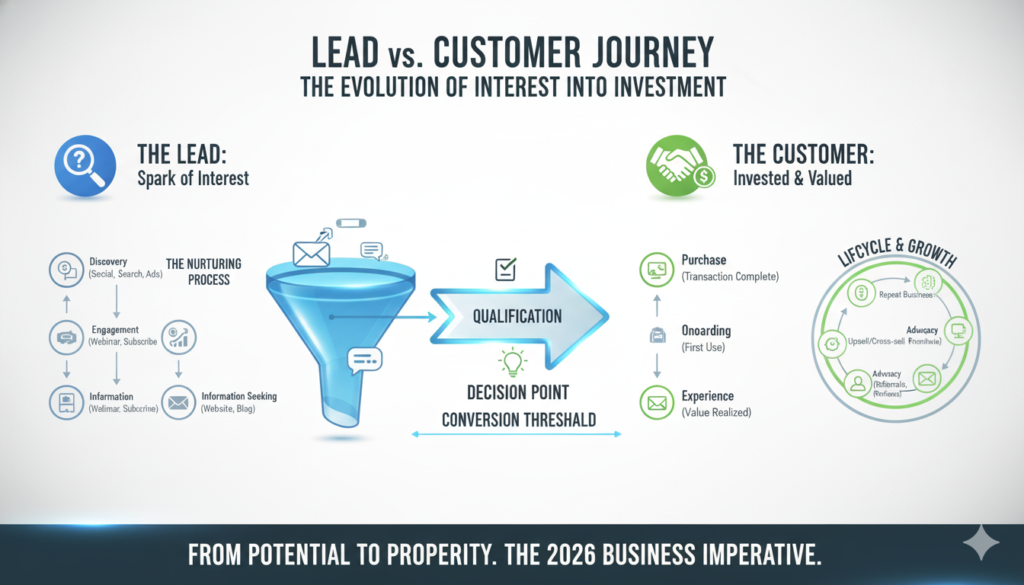
⭐ 1. What Is a Lead? (2026 Definition)
A lead is someone who:
- Shows interest
- Shares contact details
- Engages with your content
- Visits your website
- Downloads something
- Fills a form
- Clicks an ad
A lead is not ready to buy immediately, but they are potential buyers.
Examples of leads:
- Someone who fills out a real estate inquiry form
- A person who downloads your brochure
- A visitor who chats with your WhatsApp bot
- A business owner who requests a quote
Lead generation services help you attract these people and bring them into your sales system.
⭐ 2. What Is a Customer? (2026 Definition)
A customer is someone who:
- Has purchased from you
- Has paid
- Has taken action
- Trusts your brand enough to buy
Customers are the results of strong follow-up + nurturing + value delivery.
A customer is not just a buyer… they are your revenue source.
⭐ 3. Lead vs Customer: Key Differences at a Glance
| Feature | Lead | Customer |
|---|---|---|
| Interest Level | Curious | Confident |
| Stage of Journey | Early Stage | Final Stage |
| Trust Level | Low | High |
| Buying Intent | Developing | Completed |
| Business Value | Future potential | Immediate income |
| Goal | Nurture | Retain / Upsell |
Understanding this difference helps you treat them correctly—not every lead should be sold to immediately.
⭐ 4. Why This Difference Matters in 2026
2026 will be a turning point for businesses because:
- Online ads are expensive
- Competition is rising
- Customers compare everything
- Buyers trust brands slowly
- Personalization is the new standard
If you mix up lead and customer, your marketing and sales will fail.
Here’s why it really matters 👇
✔ 4.1 You Market Them Differently
Leads need:
- Follow-ups
- Value content
- Trust building
- Nurturing
- Free offers
Customers need:
- Service
- Support
- Upsell offers
- Retention plans
When you separate the two, your marketing becomes sharper and more effective.
✔ 4.2 Your Lead Generation Service Works Better
Businesses that treat leads like ready customers experience:
❌ Low conversion
❌ Wasted ad budget
❌ Bad follow-ups
❌ Loss of trust
But when you treat leads as “potential buyers,” your lead generation service becomes:
✔ More predictable
✔ Lower cost
✔ Higher conversion
✔ Easy to scale
✔ 4.3 You Don’t Force the Sale Too Early
People buy fast only when they trust you.
Lead nurturing helps you build that trust with:
- Email drips
- WhatsApp automation
- Retargeting ads
- Case studies
- Reviews
Once trust builds, the lead becomes a customer naturally.
✔ 4.4 Helps You Build a Future Customer Pipeline
Your leads today become your customers tomorrow.
With a proper pipeline:
- Sales become consistent
- Revenue becomes predictable
- You don’t depend on luck
- You beat competitors easily
This is why every business in 2026 needs a lead generation service to stay alive.
⭐ 5. How to Convert Leads Into Customers (2026 Proven Framework)
Step 1: Capture Leads Properly
Use forms, landing pages, chatbots, ads, and funnels.
Step 2: Qualify the Leads
Find who is serious and who is just browsing.
Step 3: Nurture and Educate Them
Add value through emails, WhatsApp content, videos, offers, FAQs.
Step 4: Build Trust
Share reviews, testimonials, success stories.
Step 5: Follow Up Consistently
80% of conversions happen after 5–12 follow-ups.
Step 6: Close the Sale
Once ready, turn the lead into a customer with a strong offer.
⭐ 6. Final Conclusion
Leads and customers are completely different.
A lead is the start of the journey.
A customer is the goal.
In 2026, businesses that understand this difference and invest in proper lead generation services will dominate the market, reduce marketing costs, and keep consistent sales.
If you can manage leads smartly, you can turn your business into a predictable revenue machine.